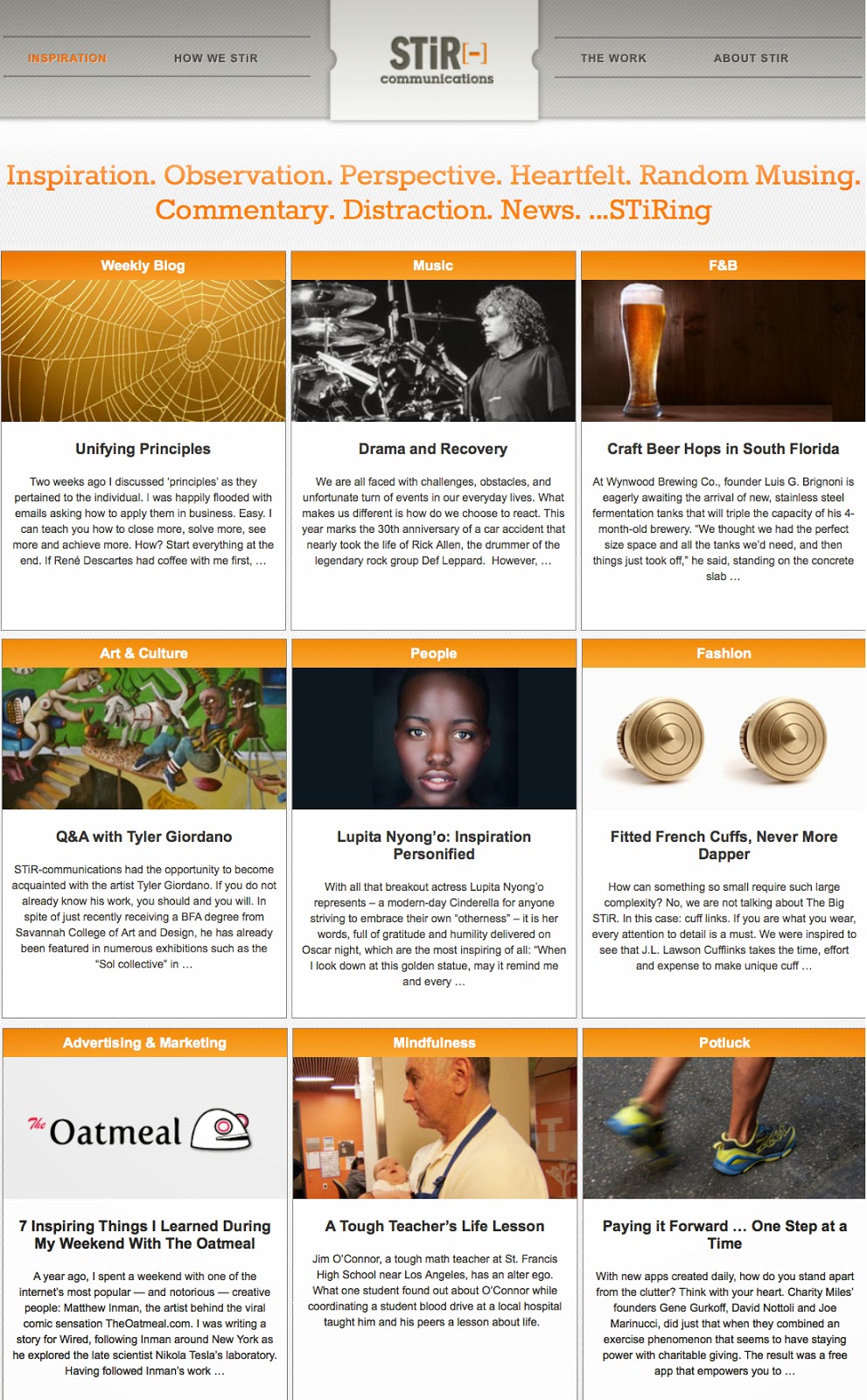
Since our last post, our blog has changed homes and found inspiration.
In an effort to share what moves us, and ultimately hoping to create a conversation about what inspires each of us, we have upgraded our blog from a single entity into a comprehensive webpage on our website dubbed "Inspiration."
To further emphasize the importance of this and showcase the impact that it has on all we do (we are much more than traditional advertising, marketing and public relations), we have dedicated the first navigational tab on our website to promoting 9 categories of items that inspire us: blog, music, food and beverage, art and culture, people, fashion, advertising and marketing, mindfulness and potluck. All will be updated monthly, with the blog changing weekly.
We hope you'll come for our blog, and stay for our page.
Learn more at www.stir-communications.com/inspiration/
Wednesday, March 12, 2014
Monday, December 30, 2013
Proof that STiR is a leader ... years ahead of The New York Times
On Monday, April 11, 2011, Greg Salsburg, CEO and The Big STiR of STiR-communications, shared his thoughts on how "thought leadership" should really be tweaked in thinking and action to "thought provider."
More than 2 years later, The New York Times agrees.
Read both articles below.
-----------------------------------------------------------------------------------------------------------------------------
By DAVID BROOKS
December 16, 2013
December 16, 2013
Little boys and girls in ancient Athens grew up wanting to be philosophers. In Renaissance Florence they dreamed of becoming Humanists. But now a new phrase and a new intellectual paragon has emerged to command our admiration: The Thought Leader.
The Thought Leader is sort of a highflying, good-doing yacht-to-yacht concept peddler. Each year, he gets to speak at the Clinton Global Initiative, where successful people gather to express compassion for those not invited. Month after month, he gets to be a discussion facilitator at think tank dinners where guests talk about what it’s like to live in poverty while the wait staff glides through the room thinking bitter thoughts.
He doesn’t have students, but he does have clients. He doesn’t have dark nights of the soul, but his eyes blaze at the echo of the words “breakout session.”
Many people wonder how they too can become Thought Leaders and what the life cycle of one looks like.
In fact, the calling usually starts young. As a college student, the future Thought Leader is bathed in attention. His college application essay, “I Went to Panama to Teach the Natives About Math but They Ended Up Teaching Me About Life,” is widely praised by guidance counselors. On campus he finds himself enmeshed in a new social contract: Young people provide their middle-aged professors with optimism and flattery, and the professors provide them with grade inflation. He is widely recognized for his concern for humanity. (He spends spring break unicycling across Thailand while reading to lepers.)
Not armed with fascinating ideas but with the desire to have some, he launches off into the great struggle for attention. At first his prose is upbeat and smarmy, with a peppy faux sincerity associated with professional cheerleading.
Within a few years, though, his mood has shifted from smarm to snark. There is no writer so obscure as a 26-year-old writer. So he is suddenly consumed by ambition anxiety — the desperate need to prove that he is superior in sensibility to people who are superior to him in status. Soon he will be writing blog posts marked by coruscating contempt for extremely anodyne people: “Kelly Clarkson: Satan or Merely His Spawn?”
Of course the writer in this unjustly obscure phase will develop the rabid art of being condescending from below. Of course he will confuse his verbal dexterity for moral superiority. Of course he will seek to establish his edgy in-group identity by trying to prove that he was never really that into Macklemore.
Fortunately, this snarky phase doesn’t last. By his late 20s, he has taken a job he detests in a consulting firm, offering his colleagues strategy memos and sexual tension. By his early 30s, his soul has been so thoroughly crushed he’s incapable of thinking outside of consultantese. It’s not clear our Thought Leader started out believing he would write a book on the productivity gains made possible by improved electronic medical records, but having written such a book he can now travel from medical conference to medical conference making presentations and enjoying the rewards of being T.S.A. Pre.
By now the Thought Leader uses the word “space” a lot — as in, “Earlier in my career I spent a lot of time in the abject sycophancy space, but now I’m devoting more of my energies to the corporate responsibility space.”
The middle-aged Thought Leader’s life has hit equilibrium, composed of work, children and Bikram yoga. The desire to be snarky mysteriously vanishes with the birth of the first child. His prose has never been so lacking in irony and affect, just the clean translucence of selling out.
He’s succeeding. Unfortunately, the happy moment when you are getting just the right amount of attention passes, and you don’t realize you were in this moment until after it is gone.
The tragedy of middle-aged fame is that the fullest glare of attention comes just when a person is most acutely aware of his own mediocrity. By his late 50s, the Thought Leader is a lion of his industry, but he is bruised by snarky comments from new versions of his formerly jerkish self. Of course, this is when he utters his cries for civility and good manners, which are really just pleas for mercy to spare his tender spots.
In the end, though, a lifetime of bullet points are replaced by foreboding. Toward the end of his life the Thought Leader is regularly engaging in a phenomenon known as the powerless lunch. He and another formerly prominent person gather to have a portentous conversation of no importance whatsoever. In the fading of the light, he is gravely concerned about the way everything is going to hell.
Still, one rarely finds an octogenarian with status anxiety. He is beyond the battle for attention. Death approaches. Cruelly, it smells like reverence.
-----------------------------------------------------------------------------------------------------------------------------
Thought Providerby GREG SALSBURG
April 11, 2011
I have come to bury Caesar, not praise him. -- Julius Caesar by William Shakespeare: Act 3. Scene II
I admire many in the world of business. The ability to innovate, initiate and guide their companies to achieve desired success is astonishing. I also admire those tactile bunch that get into the mix physically, working alongside to ensure goals are achieved.
However, over the past few years a new leader has evolved. One slightly more passive than those aforementioned and possibly held in higher regard. I think this new leader would set Brutus in a venal rage.
The “Thought Leader.”
The Thought Leader has become the moniker of choice for those donning the dais of network functions. For purposes of full disclosure, I have used this term often and have been called one by many. OK, by a few … OK, once and it was a family member, but I assumed it was implied many other occasions.
I digress.
The world went array and we looked to leaders for opinions. We elevated those thoughts because we felt ours were somehow askew. However, great leaders, great companies, great people don't just THINK, they ACT and equally GIVE. I don't want to be associated with or be known anymore as a Thought Leader, I seek for "Thought Provider."
My suggestion reminds leaders of their very essence, to lead. And, that is much more powerful.
Greg
Gregory Salsburg
CEO/The Big STIR
STIR-Communications
Miami | New York | London
c: (561) 386-8064
o: (305) 407-1723
e: Greg@STIR-Communications.com
Wednesday, August 7, 2013
Skill vs. Attitude
In the mid 80′s sales guru Zig Ziglar
stood at a whiteboard and smiled at the 20 students staring back at him
with big eyes. Zig had written several bestselling books and created
America’s most popular sales training program. The 20 students were
neophyte managers, trembling with excitement at having been chosen to be
in that room.
Marker in hand, Zig said, “Name for me every attribute of the perfect employee.”
Students called out attributes while Zig wrote them down. They had nearly 90 on the board before they began to slow.
“Can you think of any others?” They painfully named two dozen more.
“Think hard. I want you to describe the perfect employee. I need every attribute.” They studied that whiteboard until they began to sweat. They got to 114.
Pointing now at the first word on the list, Zig asked, “Is this a skill or an attitude?” They said it was an attitude. Zig wrote a big “A” next to it. Pointing at the second word, he asked, “Skill or attitude?” Another big “A.”
Twenty minutes later, Zig tallied the final score: of the 114 attributes on the list, only 7 could be classified as “Skills.” Five were “Skills/Attitudes,” and a whopping 102 of them were purely “Attitude.”
Zig could have saved himself 30 minutes by just blurting out the punch line: “Employees don’t lose their jobs because they lack skill. They lose their jobs because they don’t have a good attitude.” But Zig didn’t want to say these things and then try to convince them of their truth. Zig wanted them to say it and thus convince them to “always hire people who have the right attitude.”
By now you should be drenched in realization that you are attracted to me and our firm equally for our attitude, as our skill set, AND yes this is deliberate!
“I know one man of really brilliant parts who has not the ability to manage a business of his own, and yet who is absolutely worthless to anyone else, because he carries with him constantly the insane suspicion that his employer is oppressing, or intending to oppress him… Tonight this man walks the streets looking for work, the wind whistling through his threadbare coat. No one who knows him dare employ him, for he is a regular fire-brand of discontent.” – Elbert Hubbard
I had a similar moment with the great Deidre Krause. “I finally figured out how to improve employee morale,” I said. “Productivity skyrockets and everyone loves coming to work. It’s a program that never fails. Works every time.”
She sat there looking at me.
I stood there looking at her.
Finally, she raised her shoulders and turned her palms upward. Looking steadily into my eyes, I said, “Fire all the unhappy people.” I could see those words struck her with relief and agreement but also with such comical force that she began to laugh. But I wasn’t laughing.
None of us wants to run a sweatshop. None of us wants to be that hard-hearted boss who fails to appreciate the humanity of employees. None of us wants to abuse our people with the cold pragmatism displayed by many in corporate America.
BUT this is why so many businesses become country clubs for employees. I’ve played victim to it from time to time but it’s a focus to never be repeated and squelch offenders with a heavy hand.
Here’s how it happens: a whiner makes a reasonable request and you grant it. That request is expanded upon and accelerated until it ceases to be a privilege granted to employees and becomes an inalienable right. And that was only the first request in an unending stream of others brought to you by an increasingly dissatisfied staff. And you, sadly, are now seen as the oppressive dictator.
It’s time the “Dictator” delivers the declaration of independence to the whiner.
My advice, and Deidre’s agreement, is that you identify the “firebrand of discontent” within your company – if you have one – and give that person a smiling declaration of independence as you shake their hand, thank them for their months of service, and say, “You are now Free… free to go.”
Marker in hand, Zig said, “Name for me every attribute of the perfect employee.”
Students called out attributes while Zig wrote them down. They had nearly 90 on the board before they began to slow.
“Can you think of any others?” They painfully named two dozen more.
“Think hard. I want you to describe the perfect employee. I need every attribute.” They studied that whiteboard until they began to sweat. They got to 114.
Pointing now at the first word on the list, Zig asked, “Is this a skill or an attitude?” They said it was an attitude. Zig wrote a big “A” next to it. Pointing at the second word, he asked, “Skill or attitude?” Another big “A.”
Twenty minutes later, Zig tallied the final score: of the 114 attributes on the list, only 7 could be classified as “Skills.” Five were “Skills/Attitudes,” and a whopping 102 of them were purely “Attitude.”
Zig could have saved himself 30 minutes by just blurting out the punch line: “Employees don’t lose their jobs because they lack skill. They lose their jobs because they don’t have a good attitude.” But Zig didn’t want to say these things and then try to convince them of their truth. Zig wanted them to say it and thus convince them to “always hire people who have the right attitude.”
By now you should be drenched in realization that you are attracted to me and our firm equally for our attitude, as our skill set, AND yes this is deliberate!
“I know one man of really brilliant parts who has not the ability to manage a business of his own, and yet who is absolutely worthless to anyone else, because he carries with him constantly the insane suspicion that his employer is oppressing, or intending to oppress him… Tonight this man walks the streets looking for work, the wind whistling through his threadbare coat. No one who knows him dare employ him, for he is a regular fire-brand of discontent.” – Elbert Hubbard
I had a similar moment with the great Deidre Krause. “I finally figured out how to improve employee morale,” I said. “Productivity skyrockets and everyone loves coming to work. It’s a program that never fails. Works every time.”
She sat there looking at me.
I stood there looking at her.
Finally, she raised her shoulders and turned her palms upward. Looking steadily into my eyes, I said, “Fire all the unhappy people.” I could see those words struck her with relief and agreement but also with such comical force that she began to laugh. But I wasn’t laughing.
None of us wants to run a sweatshop. None of us wants to be that hard-hearted boss who fails to appreciate the humanity of employees. None of us wants to abuse our people with the cold pragmatism displayed by many in corporate America.
BUT this is why so many businesses become country clubs for employees. I’ve played victim to it from time to time but it’s a focus to never be repeated and squelch offenders with a heavy hand.
Here’s how it happens: a whiner makes a reasonable request and you grant it. That request is expanded upon and accelerated until it ceases to be a privilege granted to employees and becomes an inalienable right. And that was only the first request in an unending stream of others brought to you by an increasingly dissatisfied staff. And you, sadly, are now seen as the oppressive dictator.
It’s time the “Dictator” delivers the declaration of independence to the whiner.
My advice, and Deidre’s agreement, is that you identify the “firebrand of discontent” within your company – if you have one – and give that person a smiling declaration of independence as you shake their hand, thank them for their months of service, and say, “You are now Free… free to go.”
Words to Live By: Rules vs. Principles
“Be the exception not the rule.” I say this often, and often mean be
exceptional and not the expected.
However, at the root I try to reinforce that principles are more important than rules.
Laid side-by-side, a stick and a rope of the same length share a similar appearance. Likewise, rules and principles look alike even though they have virtually nothing in common.
Rules are like sticks.
You can prod people with them.
You can threaten people with them.
You can beat people with them.
But you cannot lead people with them.
When a rule doesn’t fit the circumstance, your only choice is to break it.
Principles are like ropes, able to conform to the shape of any problem. They are less brittle than rules, and thus stronger. Principles whisper valuable advice when needed most and when applied regularly shape you from the inside out. Rules only shape you from the outside in. Unlike rules, people are happily led by principles, often wearing them like a badge of honor.
A rule requires obedience.
A principle requires contemplation.
People are often complaining about the abundance of rules. Ever once hear that about principles? I am sure you have heard, “rules are meant to be broken.” Ever once hear that about principles?
I admonish tyrannical beings who seek to lead by rules. I secretly (and not so secretly) reveled in their misfortunes and demise.
I have aligned myself with those who are far from flawless but whose principles are unwavering.
Rules are demanded by people who have not the wit to understand and apply the appropriate, all-encompassing principle.
My principle? Have principles!
However, at the root I try to reinforce that principles are more important than rules.
Laid side-by-side, a stick and a rope of the same length share a similar appearance. Likewise, rules and principles look alike even though they have virtually nothing in common.
Rules are like sticks.
You can prod people with them.
You can threaten people with them.
You can beat people with them.
But you cannot lead people with them.
When a rule doesn’t fit the circumstance, your only choice is to break it.
Principles are like ropes, able to conform to the shape of any problem. They are less brittle than rules, and thus stronger. Principles whisper valuable advice when needed most and when applied regularly shape you from the inside out. Rules only shape you from the outside in. Unlike rules, people are happily led by principles, often wearing them like a badge of honor.
A rule requires obedience.
A principle requires contemplation.
People are often complaining about the abundance of rules. Ever once hear that about principles? I am sure you have heard, “rules are meant to be broken.” Ever once hear that about principles?
I admonish tyrannical beings who seek to lead by rules. I secretly (and not so secretly) reveled in their misfortunes and demise.
I have aligned myself with those who are far from flawless but whose principles are unwavering.
Rules are demanded by people who have not the wit to understand and apply the appropriate, all-encompassing principle.
My principle? Have principles!
Change Your Life’s Prism
Through what lenses do you examine possibilities?
The first 2 lenses are intellect and emotion. Sometimes you use one, sometimes the other. This is normal.
Intellect employs hard facts and cold logic. Emotion relies on soft intuition and warm connections.
Will the first impression be made in the head or in the heart?
In all your communication and attempts at persuasion – especially in your advertising – be careful to make a deep, dual impression; one track in the head and another in the heart.
But what happens after that first impression has been made? Are there other, smaller lenses that read the second, third, and fourth impressions?
My friend Larry recently told me that a careful examination of all the biggest non-fiction books of the past 50 years revealed 4 common characteristics. These patterns solve riddles that few have ever considered.
Unless you’re a non-fiction author, you don’t really care what makes a non-fiction book successful, do you? But what if I told you these same 4 characteristics are the keys to successful advertising? I saw that. Your ears perked up like a hungry German Shepherd.
Communication, to be highly successful, must have:
1. A Big Idea
- Concept
- Insight
- Information
2. Nuts & Bolts
- How To Step-by-Step Instructions
- Examples
3. Entertainment
- Writing style
- Anecdotes
- Adventure
- Surprise
4. Hope
- Visualized Happiness
- Promise
- Inspiration
(1.) The Big Idea and (2.) Nuts and Bolts are more about the writer than the reader. Yet, these are the only things every writer of non-fiction feels a need to share. And now you know why we churn out more than one million dull new books each year and why most of our advertising is gruel.
Dull communications are about the speaker, the author, the product, the advertiser. Lots of examples supporting a big idea are merely white noise – the sound of traffic in a too-busy world – when there’s no entertainment and no hope.
Successful non-fiction – including highly effective advertising – is about the reader, the listener, the viewer, the customer. These beloved messages deliver (3.) Entertainment and (4.) Hope.
Larry shared with me this Big Idea. We can use it to lift the effectiveness of our communications to new heights. This should give you Hope.
The first 2 lenses are intellect and emotion. Sometimes you use one, sometimes the other. This is normal.
Intellect employs hard facts and cold logic. Emotion relies on soft intuition and warm connections.
Will the first impression be made in the head or in the heart?
In all your communication and attempts at persuasion – especially in your advertising – be careful to make a deep, dual impression; one track in the head and another in the heart.
But what happens after that first impression has been made? Are there other, smaller lenses that read the second, third, and fourth impressions?
My friend Larry recently told me that a careful examination of all the biggest non-fiction books of the past 50 years revealed 4 common characteristics. These patterns solve riddles that few have ever considered.
Unless you’re a non-fiction author, you don’t really care what makes a non-fiction book successful, do you? But what if I told you these same 4 characteristics are the keys to successful advertising? I saw that. Your ears perked up like a hungry German Shepherd.
Communication, to be highly successful, must have:
1. A Big Idea
- Concept
- Insight
- Information
2. Nuts & Bolts
- How To Step-by-Step Instructions
- Examples
3. Entertainment
- Writing style
- Anecdotes
- Adventure
- Surprise
4. Hope
- Visualized Happiness
- Promise
- Inspiration
(1.) The Big Idea and (2.) Nuts and Bolts are more about the writer than the reader. Yet, these are the only things every writer of non-fiction feels a need to share. And now you know why we churn out more than one million dull new books each year and why most of our advertising is gruel.
Dull communications are about the speaker, the author, the product, the advertiser. Lots of examples supporting a big idea are merely white noise – the sound of traffic in a too-busy world – when there’s no entertainment and no hope.
Successful non-fiction – including highly effective advertising – is about the reader, the listener, the viewer, the customer. These beloved messages deliver (3.) Entertainment and (4.) Hope.
Larry shared with me this Big Idea. We can use it to lift the effectiveness of our communications to new heights. This should give you Hope.
5 Career Game Changers To Win Relevancy and Rewards by Peter Gruber
By Peter Gruber
What’s the secret to becoming the most highly paid and recognized individual in your field?
Legendary, Emmy-award winning television sportscaster, Al Michaels, famous for shouting one of the most memorable sports lines of all time – “do you believe in miracles?” – during the U.S. victory over the Russian hockey team at the 1980 Olympics, as well as being the only play-by-play commentary/host to cover the four major sports championships: the Super Bowl (6 times), World Series (8 times), NBA Finals (2 times) and the Stanley Cup Final (3 times) – and reaping impressive financial rewards from his successes- recently conversed with our UCLA Masters Class on The Business of Sports.
Michaels exhorts 5 strategies that propelled and sustained his enormous success followed by my declarations of how you can adapt them to get your winning edge to stay relevant and highly rewarded in your business.
Original posting of article.
What’s the secret to becoming the most highly paid and recognized individual in your field?
Legendary, Emmy-award winning television sportscaster, Al Michaels, famous for shouting one of the most memorable sports lines of all time – “do you believe in miracles?” – during the U.S. victory over the Russian hockey team at the 1980 Olympics, as well as being the only play-by-play commentary/host to cover the four major sports championships: the Super Bowl (6 times), World Series (8 times), NBA Finals (2 times) and the Stanley Cup Final (3 times) – and reaping impressive financial rewards from his successes- recently conversed with our UCLA Masters Class on The Business of Sports.
Michaels exhorts 5 strategies that propelled and sustained his enormous success followed by my declarations of how you can adapt them to get your winning edge to stay relevant and highly rewarded in your business.
- Be flexible –Michaels gleaned over his many years
as a leading-edge sportscaster that the audience viewing habits changed.
Instead of staying dormant in one place watching three hours of sports,
the audience was more distracted and was active with sometimes two or
more other tasks, bringing them in and out of game play. Recognizing
what the audience really wanted, he adapted his announcing style to
incorporate the repetition of certain key elements in the story to be
sure his audience stayed connected with the narrative.
Get Your Winning Edge By…staying attuned and in tune with your audience. As they change, you must adapt to stay relevant and attractive. You must evolve or become extinct. This is an issue of attitude more than aptitude. If you want a long career, in order to not become “old dog,” you must learn new “tricks.” - Limit the Lingo – Michaels is at the epicenter of
one of the most formidable assets in professional sports media, NFL
Sunday Night football, as its anchor sportscaster. Michaels points out
his audience has grown tremendously largely as a result of the increased
percentage of women who have been drawn to it and follow it. Michaels
attributes this, in part, to making this sport accessible by not using
too much unique vernacular. It can’t be a clinic. The ideas can be
sophisticated and it can be rich content, but it has to be inclusive.
You’re always trying to enlarge your audience.
Get Your Winning Edge By…understanding that in your business you ought not be speaking up or down to your audience, but that you’re speaking with them. You must communicate so they understand easily and “get” the value proposition of your offering and are compelled to take the action you want. Don’t let your ego get in the way to show how smart and clever you are. It’s about the connection, so it’s important to speak the language and the tone that aligns with your audience. This will support you in sustaining and growing your audience (customers and clients) and will enhance your reputational and economic value. - Use technology purposefully – Michaels points out
that there is no doubt that technologicaladvances have enhanced the
viewer experience. But, it is just a frosting, and too much frosting can
overwhelm the cake. Using technology just to show off can backfire as
it did when a decision was made to put a light weight camcorder on a
jockey’s head to capture a race, and the viewer experience of bouncing
on the horse was nauseating. Whereas the Skycam, which was started in
the competitive football league, was so successful that adapting it by
the NFL became a boon to the audience’s enjoyment of the game.
Get Your Winning Edge By… understanding that new technology when purposefully applied can deepen the connection to your audience, or when indiscriminately or over used becomes a cold comfort. It’s not about the features of the technology, i.e., how it works, but whether the benefit (what’s in it for them) adds real value to your audience. It can position you as a thought leader who is able to execute on your thoughts and deliver the benefit to your audience. This will escalate your currency inside and outside of your organization. It will advance the development of your personal brand. And, most importantly, it will differentiate you from your competitors who may seek the same audience, job or promotion. - Truth rules – In journalism Michaels believes that truthfulness begets trust and respect. Because of his commitment to the truth, Al felt he was more often granted an interview from someone who otherwise would have been reluctant to speak with the press. Get Your Winning Edge By… being authentic. In today’s technological world, untruths can be revealed in mere seconds and reputations can be instantly and often irreparably damaged. It’s always far harder to regain trust than it is to earn it, so build and grow your relationship with your employer and your customers based on authenticity and transparency. This will solidify your relationship in good times and bad.
- Propel connections – according to Michaels, the most “popular” sports are the ones that create and maintain an emotional fan connection. Connection is the key. Fans must believe they own the team and they make a difference. And Michaels must facilitate this connection to earn their loyalty. Get Your Winning Edge By… identifying what stakeholders (both up and down your food chain) are most important to your success and be sure to make an emotional (not merely intellectual or informational) connection to them. This emotional connection, through the stories you tell or the experiences you share, fosters a deeper relationship making you the more “popular” and favorable selection than your competition.
Original posting of article.
Better than Creativity ...
A rich knowledge of history is better than creativity.
Let me qualify that. A rich knowledge of history is better than creativity if your goal is to make money.
The most profitable form of creativity is to repurpose the proven.
Do you want to put together a group of colors that create a powerful effect? Maybe for a website or a sign or a brochure or a living room?
Common sense will tell you to hire an expert. That expert will ask you to describe the feelings you want the color scheme to conjure and then he or she will aim all their education, talent and experience toward doing what has already been done by minds far greater than their own.
Yes, common sense would tell you to hire a talented expert. But common sense is merely the name we give the collection of prejudices we acquire before the age of eighteen. (If you feel you’ve heard that statement before, it’s because Albert Einstein famously said it in the 1952 book, Mathematics, Queen and Servant of the Sciences.) Common sense is overrated.
An enlightened soul who has escaped the boundaries of common sense will quietly inquire of the giants whose footprints went deep into the earth, those giants whose fingerprints can be found on the hearts of billions of people they have touched.
Why pay a lightweight for advice when you can consult Gustav Klimt, Pierre-Auguste Renoir and Vincent van Gogh for free?
No, don’t trust me. Trust the giants.
Lee Iacocca was chosen as one of Ford Motor Company’s ten “Whiz Kids” in 1946. But every time young Lee would go to his boss with a suggestion, his boss would say, “Show me where it has worked.”
Your first impression of this man is that he was a follower, a lemming, a conformist with no courage or imagination, right? But Iacocca credits that boss as being the man responsible for all his later successes. Iacocca learned from him a pivotal lesson: if an idea is truly brilliant, you’ll find examples of its successful implementation scattered throughout history.
The road to bankruptcy court is flanked on both sides by bright-eyed “creative people” dripping with enthusiasm. Ask any one of them for directions. They’ll make sure you get there.
The secret of guaranteed success is to import a tested and reliable methodology into a business category where it has never been used.
Repurpose the proven.
They’ll call you a brilliant creative innovator. You might even be able to patent your breakthrough.
But you and I know the truth. You’re merely an insightful historian.
Let me qualify that. A rich knowledge of history is better than creativity if your goal is to make money.
The most profitable form of creativity is to repurpose the proven.
Do you want to put together a group of colors that create a powerful effect? Maybe for a website or a sign or a brochure or a living room?
Common sense will tell you to hire an expert. That expert will ask you to describe the feelings you want the color scheme to conjure and then he or she will aim all their education, talent and experience toward doing what has already been done by minds far greater than their own.
Yes, common sense would tell you to hire a talented expert. But common sense is merely the name we give the collection of prejudices we acquire before the age of eighteen. (If you feel you’ve heard that statement before, it’s because Albert Einstein famously said it in the 1952 book, Mathematics, Queen and Servant of the Sciences.) Common sense is overrated.
An enlightened soul who has escaped the boundaries of common sense will quietly inquire of the giants whose footprints went deep into the earth, those giants whose fingerprints can be found on the hearts of billions of people they have touched.
Why pay a lightweight for advice when you can consult Gustav Klimt, Pierre-Auguste Renoir and Vincent van Gogh for free?
- Go online and select a series of world-famous paintings whose color palettes have the mojo you seek. (Mojo, by the way, is just the name we give to high-voltage emotional juju. Einstein didn’t say this, but I’m pretty sure it’s true, anyway.)
- Download only the paintings of artists who rocked the world.
- Import those paintings into Photoshop and sample each of the four or five principal colors. Click a couple of buttons to reveal the precise CMYK formulation of each. BAM!
No, don’t trust me. Trust the giants.
Lee Iacocca was chosen as one of Ford Motor Company’s ten “Whiz Kids” in 1946. But every time young Lee would go to his boss with a suggestion, his boss would say, “Show me where it has worked.”
Your first impression of this man is that he was a follower, a lemming, a conformist with no courage or imagination, right? But Iacocca credits that boss as being the man responsible for all his later successes. Iacocca learned from him a pivotal lesson: if an idea is truly brilliant, you’ll find examples of its successful implementation scattered throughout history.
The road to bankruptcy court is flanked on both sides by bright-eyed “creative people” dripping with enthusiasm. Ask any one of them for directions. They’ll make sure you get there.
The secret of guaranteed success is to import a tested and reliable methodology into a business category where it has never been used.
Repurpose the proven.
They’ll call you a brilliant creative innovator. You might even be able to patent your breakthrough.
But you and I know the truth. You’re merely an insightful historian.
Red Bull: STiR-communications Marketing Company of the Year
To know me is to know I am on the go from the get-go. I move fast,
talk fast, my ADD has a case of ADD, and have been accused of being
heavily caffeinated. Guilty of all, however, one thing I don’t have is
wings. That has not stopped me from admiring the legions of angels who
do.Our Marketing Company of the Year: Red Bull.
Even though Red Bull has been credited with inventing the energy drink industry, they do not sell you an ounce of it. If you look closely at their marketing, they sell you adrenaline, they sell you action, they sell you passion. They just happened to bottle it into a small blue and silver can than contains taurine. That is one of the most masterful sales in history.
Go to its Facebook page, which is closing on 35 million fans as of this writing, and you will be hard pressed to find a single picture or a mention of the Red Bull bottle. As a matter of fact go to their homepage and you will also have great difficulty finding a single picture of the product on such prime real estate. Red Bull marketing does not sell you drinks. Red Bull may taste like carbonated medicine in a can while promising physical energy through glucose or a mixture of sugars, but it’s much more – it’s the most dominating aspirational brand in the category since Coca Cola.
As I write laying next to me is its lifestyle magazine, to which I subscribe. That’s right, I do not drink the product, but Red Bull has captured me and millions of others within its brand attributes.
In-Bound Marketing
In quarter three in 2012, Red Bull sponsored a skydiving jump from space. The skydive jump for Felix Baumgartner was delayed for weather reasons on three separate occasions and critics were questioning why would Red Bull would dump so much money in sponsoring such an event when their objective is to sell drinks. What critics were not paying attention to was the legions of followers online during this timeframe.
Red Bull’s marketing strategy was born via an in-bound marketing strategy of two-way communication and during the period of time when the launch was delayed amassed a huge social media following. Red Bull’s Facebook page is currently ranked 41st, which is ahead of Starbucks, Harry Potter, and McDonald’s. There is only one beverage company that is ahead of Red Bull in Facebook rankings: Coca-Cola. It would be wise to watch its back … In more ways than one.
To answer the question of why, well, for one it broke the record of the most watched live streaming event on YouTube with over 8 million people. The previous record you might ask? It was the London Olympics with an audience of 500,000 concurrent streams. Red Bull smashed the previous record by a multiple of 16! No small feat indeed. Then, according to the Huffington Post: besides YouTube, the jump was shown by more than 40 TV stations and 130 digital outlets. Red Bull’s Facebook post-jump photo of Baumgartner gained almost 216,000 likes, 10,000 comments and over 29,000 shares within 40 minutes, and half the worldwide trending topics on Twitter were related to Red Bull.
Do these benefits translate into profits for the company? That is hard to say since Red Bull is private and does not report its financial statements; however, it would be a very safe bet to say that the skydive from the edge of space, the three-peat Constructor’s Championship in Formula 1, along with Sebastian Vettel’s three-peat Formula 1 Driver Championships, the numerous Flugtag events, and the tons of other non-traditional sponsorships cannot have hurt. In fact, it is known that back in 2010 it sold 4.2 billion cans worldwide with just over a billion of them here in the United States. That represented a jump in revenue of 15.8% year over year. What was Coca-Cola’s increase? Between 3 and 4%.
There is no question that Red Bull Marketing is a force to be reckoned with. I sincerely believe that 2012 will be shown to have been the inflection point in Red Bull’s meteoric rise to the top. I have said it before and I’ll say it again, strategy is not about doing things better, it is about doing things differently. Red Bull has its headquarters in Austria near Salzburg (birthplace of Wolfgang Amadeus Mozart) in a town called Fuschl. Not your typical seat of a multi-billion dollar conglomerate. Yet, there is nothing typical about Red Bull nor its marketing. Red Bull has thrown the old marketing book out the window and is writing its own. We should all be so lucky to peruse it.
How Red Bull Did It
In today’s society, consumers are bombarded with promotional messages from organizations. Consumers receive these messages when they listen to the radio, watch television, read a newspaper, commute to work or simply walk around a city. Effective promotion relies on the message reaching the consumer in an accurate and timely way. However, there are so many messages it can be difficult for a business to reach its target audience. Promotional messages can easily become simply noise. They crowd the marketplace and make everything more confusing for consumers. This creates a marketing problem. To address this problem, some marketers look for new ways to communicate with consumers. They seek to break the traditional rules of marketing by reaching consumers in innovative ways.
Dietrich Mateschitz founded Red Bull in 1984 after discovering the widespread popularity of tonic drinks in the Far East. He developed the Red Bull Energy Drink, launching the product on the Austrian market in 1987. Since then, Red Bull has launched a range of products, including Red Bull Cola in 2008 and Red Bull Energy Shots in 2009. Today, Red Bull has annual sales of around 4 billion cans in 160 countries and employs more than 7,700 people. Red Bull has a distinctive approach to marketing: using a progressive marketing strategy. This type of strategy aims to constantly evolve and develop the brand. This approach allows Red Bull to engage with consumers using new and exciting channels of communication.
In recent years social media has become a vital marketing tool for many organizations. Its increasing popularity, predominantly with young audiences, has had a huge impact on modern marketing techniques. Digital and social media campaigns are integral to Red Bull’s marketing strategy. This case study illustrates how Red Bull uses a range of innovative promotional techniques to improve the process of communication and drive consumer engagement and loyalty.
To meet the needs of its customers, every organization seeks a distinctive marketing mix. This is often referred to as the 4Ps. It involves focusing on:
- product – the specific features and benefits of the product
- place – where and how the product is sold
- price – setting the right price in each market
- promotion – using the most suitable form of promotion to reach customers
- A distinctive product – the taste of the product is unlike any other, it also has a functional effect in comparison to other soft drinks
- It is easy to obtain as it is sold in a variety of places – including retail outlets and food and drink establishments
- Red Bull uses a premium pricing strategy. The product is priced above that of competitors’ products. Consumers will pay a premium for Red Bull due to the quality of the product and the product’s benefits. This is reflected in the fact that it is the world’s best-selling energy drink.
- However, perhaps the most interesting element of Red Bull’s marketing mix is its approach to promotion. Red Bull embraces innovation within its promotional activities and as such is able to create a lasting impression on consumers. The concept behind its promotional activity is to give people ‘Wiiings’. This translates as pushing the boundaries of what is possible and nurturing people’s talent so they can achieve their goals and dreams.
There are several traditional approaches to promotion:
Advertising
Perhaps the best known is advertising. This is a key element of what is known as above-the-line promotion. This type of promotion usually delivers messages to a wide audience using the press, television, radio and the Internet. Although this makes it easy to reach a large audience, it is more difficult to deliver a memorable message that is tailored to a specific target market. It can be costly: for example, television adverts at prime time are very expensive. In addition, businesses cannot completely control who sees or hears their adverts or how they respond. Red Bull’s above-the-line promotion primarily helps to increase top of mind brand awareness amongst consumers.
Below-the-line
Below-the-line promotions encompass all other forms of promotional activity. To reach targeted groups of consumers, Red Bull focuses heavily on developing inventive below-the-line promotions. Unlike many businesses, Red Bull does not use traditional sponsorship as a method of below-the-line promotion. Red Bull takes a different approach. It creates and organizes its own events around the world. These events provide a platform for talented athletes to showcase their skills and ambition.
Sporting events include Red Bull X-Fighters and Red Bull Air Race, where the world’s top FMX riders and pilots respectively perform world-class flips, turns and tricks in front of tens of thousands of spectators. These events help to establish the brand values. They also begin the AIDA process with the participants and audiences for these events, creating awareness and interest in Red Bull products.
A key aspect of Red Bull’s promotion is about creating genuine relationships with individual athletes, such as Robbie Maddison, who was able to achieve his lifelong ambition when he performed the first ever motorcycle back flip over a raised Tower Bridge in London. Through supporting these athletes in pushing themselves beyond their limits, Red Bull is able to engage with consumers. Red Bull events provide experiences that excite, surprise and challenge participants and spectators. For example, events in summer 2011 included Red Bull cliff-diving in the south of Italy and the Red Bull Flugtag event in Leeds. Red Bull Flugtag challenges brave and creative individuals to design, build and pilot their own homemade flying machines off a 30ft-high flight deck. Almost 100 Red Bull Flugtag events have been held around the globe. Teams are judged on the distance flown, as well as the creativity and originality of their flight machine idea. They also win points for their performance during their pre-flight speech to the thousands of spectators.
Events like these support the brand ethos and contribute to the Red Bull experience. They are based on a belief that mass awareness can be achieved without requiring big budgets. In fact, the large-scale activities, such as the Formula 1 team that is owned by Red Bull, are not the cornerstone of its promotional strategy. These activities are focused on building talent and pushing the sport to new levels through innovation. However, the emphasis is on local activities that can have a big impact and create interesting media coverage. These have the advantage that the company can quickly and inexpensively change anything that is not working. It can repeat or develop ideas that work and seem to have good public appeal. The program is managed through an annual activity plan, which is based on a three-year overview of promotional work.
Pull Marketing
Word of mouth (WOM) promotion is based on the principle of pull marketing. It relies on the transmission of a positive marketing message from person to person through conversation or a personal communication such as email or text message. Pull marketing gets consumers to bring other consumers to the product. In contrast, push marketing uses above-the-line promotional techniques to put products in front of consumers in order to generate sales.
Red Bull extensively uses pull marketing. This approach involves getting consumers excited about the product and conveying this excitement to their family and friends. It is also about trying to get coverage of Red Bull events in the press. This coverage can encourage consumers to find out more about the product. It helps to generate momentum through creating interesting stories for people to talk about, which in turn helps to create brand awareness and grow sales.
The founder of Red Bull used pull marketing to promote his original product in the 1980s. He hired a Red Bull Wings Team to go out and talk to people one-to-one about the product. This helps to create consumer interest in the product. As people experience the drink and appreciate its qualities, they become advocates for the brand. They share their opinions with other consumers when they talk with friends. The promotion therefore creates a ripple effect.
Innovation
Red Bull continues to use this process to reach consumers in innovative ways, including:
Red Bull Wings Team –
The team of students go out on the road in their Red Bull mini to help launch the product in new markets. The branded mini has a Red Bull can on the back of it. The team offers a cold can of Red Bull to people in need of energy to demonstrate the product’s qualities. Through engaging consumers in a fun, non-threatening way they create a personal and positive product experience. For example, the Wings Team attended the 2010 London to Brighton mini run. The team was there for the early start to offer competitors a cold can of Red Bull.
Student Brand Manager Program –
Individual students help activate a variety of events on campus. They organize activities around the world to get people talking about the product and get students actively involved on their own university campus.
Red Bull Bedroom Jam –
This is a competition to help teenage musicians get out of their bedrooms and onto the big stage, giving them an experience they may never have been able to have. Red Bull records bands playing live from their bedrooms for the world to see via the Internet. The bands that create the most attention online then compete for long-term career support and the opportunity to play at festivals and be tour support for established musical acts. This helps create interesting media coverage that gets people talking about the brand.
Red Bull Reporter –
This project provides opportunities for aspiring writers, filmmakers and presenters to report on world-class Red Bull events, giving them the chance to have their work published in a variety of credible publications.
These creative and original projects help Red Bull to capture the attention of its increasingly knowledgeable audience. They aim to build brand loyalty by creating relationships with consumers.
Digital and Social Media
Digital and social media are core elements for all of Red Bull’s campaigns. These tools provide direct and relevant lines of communication with Red Bull’s core youth audience. Facebook, Twitter and online blogs make it easy for people to exchange information quickly between themselves. These channels of communication make word-of-mouth and other pull marketing strategies more effective.
To remain competitive and interact with consumers, Red Bull is constantly creating new ways of reaching its audiences online. Red Bull also uses a variety of smart phone applications to promote its campaigns. These methods create connections with consumers, which minimize the risk of ‘noise’ affecting the promotional message. Unlike advertising campaigns, which have to be planned months in advance, the great advantage of some of the techniques that Red Bull uses is that they are easy to adapt and refine. Red Bull constantly creates new methods and techniques to engage with consumers. This is vital in such a competitive market.
Analytics
For promotions to remain effective, Red Bull has to analyze the impact of different campaigns. Word-of-mouth promotions can be more difficult to measure than some traditional methods of promotion. Although healthy sales are an important measure, Red Bull uses other measures to evaluate the effectiveness of its activities. For example:
- Setting targets for sales returns from the smaller promotional activities.
- Evaluating the amount of editorial coverage its activities receive in the media.
- Measuring the number of blogs related to Red Bull’s products and the frequency of comment on these blogs.
- Evaluating the online influence of Red Bull activities in the social media. For example, on Twitter there are around 875,000 followers of Red Bull activities. On Facebook, more than 35,000,000 consumers ‘like’ Red Bull.
- Conducting an annual brand health-check with consumers to ensure that they like the brand.
Measuring the outcomes of Red Bull promotions is not just about return on investment. These figures do not create the whole picture. This is because it can be difficult to value word-of-mouth promotions on paper. Sales returns do not take into account other factors such as longer-term brand loyalty.
As a specific example, the Red Bull Wings Team has proved to be a very important part of the marketing strategy. When Red Bull has launched products in countries without this program as part of its promotional mix, they have not been received as well by consumers.
Red Bull adopts a progressive marketing strategy that is constantly evolving to push the brand forward. Social and digital media is at the heart of all of its promotional campaigns.
This type of strategy allows Red Bull to adapt its promotional activity to reflect technological and social changes, for example, the increasing use of smart phone applications as a channel of communication to its audience. Consumers’ expectations are higher than ever, and as such Red Bull strives to use innovative marketing techniques to reach its audience.
In short, 6 basic tenets have turned this company into the world’s leader within the energy drink category and made them STiR-communications’ Marketing Company of the Year:
- Embrace a sense of purpose
- Beyond Big Society: do more than grow your bottom line
- Move beyond ROI: pitch for emotional impact
- Embrace ‘extreme marketing’
- Behavior trumps brand values
- Place commitment above all things

STOP READING THIS!!!!!!!!!!!
“Tune in, turn on and drop out.”
When Timothy Leary famously penned the poetic LSD laced iconic phrase in 1967, it immediately entered the lexicon of underground counterculture. Leary’s sequence of personal developments was often misinterpreted to mean, “Get stoned and abandon all constructive activity.” However, this was not the intent at all; constructive activity was.
“Turn on” meant go within to activate your neural and genetic equipment. Become sensitive to the many and various levels of consciousness and the specific triggers that engage them.
“Tune in” meant interact harmoniously with the world around you – externalize, materialize, express your new internal perspectives.
“Drop out” suggested an active, selective, graceful process of detachment from involuntary or unconscious commitments. “Drop Out” meant self-reliance, a discovery of one’s singularity, a commitment to mobility, choice, and change.
Today, I would suggest we are so Tuned In and Turned On that it has created a societal detachment of pandemic proportions. Worse, the great majority are insensible to the heightened misfortune engulfing them. Take this blog for instance, why are you reading this dribble instead of doing something of substance? Seriously, that’s not self-deprecating, just self-awareness. I’m full of shit and so are most. More importantly how have you come to access this and upon what device of your many are you reading it?
The hyper-excessive ubiquity of technological advancement has simultaneously allowed us to believe we are more tuned in by being turned on. Anything we want is one click away. We can communicate with whomever and wherever we wish by the stroke of a keyboard or swipe on the screen. Are we truly better for it? In many ways we are.
As Thomas Friedman suggested, “the world is flat” and thus the barrier of entry to “do” becomes self-reliant. Many positive advancements have been spurred from this new frontier and I am not suggesting we abandon them. I love and embrace technology. Our company, STiR-communications, has become a leader in strategic public relations, inbound marketing and advertising using the very tools I fret. I just fear somewhere along the road within this progressive stratagem we have forgotten something: humans.
I am witnessing the demise of interpersonal relationships. Today’s LSD: “Little, Silly, Distractions,” and it runs rampant. Like Pavlov’s dog we react to every bell and vibrate with immediate reaction. Texting “I Love you” opposed to deeply looking into someone’s eyes and expressing it first hand. “Checking in” or announcing your actions opposed to, I don’t know, actually just being present. On that note, when was the last time you were still and intently looked at someone in the eyes for 10 minutes straight without the urge to check your email, text, Twitter, Instagram, Facebook, etc.?
I like to don a mono-chromatic attire, been accused of being mono-syllabic (yep) and of course I’m a monogamist. But my overwhelming preference is to be mono-a-mono. A task that is nearing extinction by the exhaustive execution of multitasking. Which in truth is masked multi-distraction.
So, on January 1st we are asking you to join a movement. For this ONE DAY shut it all down. No computers, smartphones or tablets. No Internet, no texting. We understand the withdrawal will be startling and many, including us, may not make it. Regardless, we want to know about it so please share your experience. For the lucky few that interact harmoniously with the world around you – externalize, materialize, express your new internal perspectives to people directly – please share your secrets.
I wish all luck and let’s Tune off, Turn off and Drop in!
When Timothy Leary famously penned the poetic LSD laced iconic phrase in 1967, it immediately entered the lexicon of underground counterculture. Leary’s sequence of personal developments was often misinterpreted to mean, “Get stoned and abandon all constructive activity.” However, this was not the intent at all; constructive activity was.
“Turn on” meant go within to activate your neural and genetic equipment. Become sensitive to the many and various levels of consciousness and the specific triggers that engage them.
“Tune in” meant interact harmoniously with the world around you – externalize, materialize, express your new internal perspectives.
“Drop out” suggested an active, selective, graceful process of detachment from involuntary or unconscious commitments. “Drop Out” meant self-reliance, a discovery of one’s singularity, a commitment to mobility, choice, and change.
Today, I would suggest we are so Tuned In and Turned On that it has created a societal detachment of pandemic proportions. Worse, the great majority are insensible to the heightened misfortune engulfing them. Take this blog for instance, why are you reading this dribble instead of doing something of substance? Seriously, that’s not self-deprecating, just self-awareness. I’m full of shit and so are most. More importantly how have you come to access this and upon what device of your many are you reading it?
The hyper-excessive ubiquity of technological advancement has simultaneously allowed us to believe we are more tuned in by being turned on. Anything we want is one click away. We can communicate with whomever and wherever we wish by the stroke of a keyboard or swipe on the screen. Are we truly better for it? In many ways we are.
As Thomas Friedman suggested, “the world is flat” and thus the barrier of entry to “do” becomes self-reliant. Many positive advancements have been spurred from this new frontier and I am not suggesting we abandon them. I love and embrace technology. Our company, STiR-communications, has become a leader in strategic public relations, inbound marketing and advertising using the very tools I fret. I just fear somewhere along the road within this progressive stratagem we have forgotten something: humans.
I am witnessing the demise of interpersonal relationships. Today’s LSD: “Little, Silly, Distractions,” and it runs rampant. Like Pavlov’s dog we react to every bell and vibrate with immediate reaction. Texting “I Love you” opposed to deeply looking into someone’s eyes and expressing it first hand. “Checking in” or announcing your actions opposed to, I don’t know, actually just being present. On that note, when was the last time you were still and intently looked at someone in the eyes for 10 minutes straight without the urge to check your email, text, Twitter, Instagram, Facebook, etc.?
I like to don a mono-chromatic attire, been accused of being mono-syllabic (yep) and of course I’m a monogamist. But my overwhelming preference is to be mono-a-mono. A task that is nearing extinction by the exhaustive execution of multitasking. Which in truth is masked multi-distraction.
So, on January 1st we are asking you to join a movement. For this ONE DAY shut it all down. No computers, smartphones or tablets. No Internet, no texting. We understand the withdrawal will be startling and many, including us, may not make it. Regardless, we want to know about it so please share your experience. For the lucky few that interact harmoniously with the world around you – externalize, materialize, express your new internal perspectives to people directly – please share your secrets.
I wish all luck and let’s Tune off, Turn off and Drop in!
Greg
Gregory Salsburg
CEO/The Big STIR
Harnessing the Power of Disruptive Principles
Going against the old axiom, “it is ain’t broke, don’t fix it.” One communications firm taking on brand change.
As our EVP Deidre Krause often says, you hurt the ones you love the most. Since we are self-obsessed, highly narcissistic and clearly love ourselves more than we love you, why not inflict this process on someone who we want to benefit the most? Our latest victim for this arduous torture: our own company, STiR-communications.
If you visit our site you will notice there have been many changes. We determined it was time to come out from the shadows and share with all our brand identity and company mission. If you viewed our video on the homepage you will see that we have never been shy at playing on the fringe. As a matter of fact and as a matter of rule, the fringe is where we focus. It’s where innovation propagates. Where tomorrow’s general acceptance is today’s feared or misunderstood. Do what’s right, not what’s easy has been a long-standing mantra at our company and a basis for the work and consult we provide our clients.
A myriad of companies within marketing, advertising and public relations have been forced of late to rethink their business models because of economic unrest. For the majority, these are reactive measures, many being implemented too late.
However, years earlier and ahead of the curve, we changed our entire method of operation and applied forward thinking initiatives that would not simply serve our clients and our company for the moment and better prepare them for the future. When we made those changes – and the many since – we have been dismissed more often than embraced. That is, except by our clients.
One of my business stewards is Harvard Business Professor Clayton Christensen. Within his book, The Innovator’s Dilemma, he describes that “most companies with a practiced discipline of listening to their best customers, and identifying new products or services that promise greater profitability and growth, are rarely able to build a case for disruptive principles regularly until it’s too late.”
So here we go again. This time the journey is emblematic of our new mission. We no longer will serve solely as thought leaders but embrace the purpose to be thought providers.
Over the coming months our newly designed site will organically grow further, serving as a resource and portal for a wealth of information pertaining to numerous business, marketing and life topics. We will update this information regularly, which will be housed in the “Inspiration” section of our website, and hope you will use and further provide this information to others.
As a first step in growing this portal organically, we ask you start by sending this email to at least five friends. Additionally, we’d love to hear from you about some topics you would like to be discussed within this section.
We will continue to deliver award winning design, forwarding thinking digital media and strategic public relations that drive our clients financial initiatives upward. But along the way and regardless if we are working for you, we hope we can provide for you.
Enjoy
Thursday, August 9, 2012
Gone, Back, Gone, But Never Forgotten
The gag order has been lifted, my vibrant prose no longer required to be heard solely by the numerous personalities running amok inside my head. (Somehow each with their own neuroses.)
My buds, Sergey and Larry continue to maintain technological dominance, and, as I predicted in our meetings, Facebook is showing the chinks in the armor of a pedestrian utility. Who could have imagined that a company that solves the needs of billions of people daily, built on a vibrant and intuitive algorithm AND has figured out how to make money, has a brighter future than one that hopes to make you their "friend"? With that said, MZ, I enjoyed our meetings, still wish you remained private and still believe the future is bright.
Too much time has passed since the last blog to catch you up on all, but I can tell you this - our company, STiR-Communications, is experiencing tremendous growth and exciting things continue to happen. We have been working with amazing companies and wonderful people, I feel blessed every day. My A.D.D. is acting up and once again I got the itch to redesign our site and the direction of our social media. As the song goes, "See you in September."
In the meantime, if you need some STiR'ing, we would love to hear from you.
Greg
Gregory Salsburg
CEO/The Big STIR
Miami | New York | London
c: (561) 386-8064
o: (305) 407-1723
c: (561) 386-8064
o: (305) 407-1723
Wednesday, October 19, 2011
GAG, ORDER!!!
When is right right? How far are you willing to go to stay true to yourself? To never waiver from personal values, even when no one else is looking. To never quit, I mean never, not even for a second. To follow your charted course even when self-doubt is more deafening than self-confidence.
Three years ago I witnessed first-hand the pervasive power of big business. I watched while one of our client's (and friend) was crushed by one of the United States' largest banks. In one fell swoop and for no apparent reason they destroyed everything he worked for. And, then for good measure, they did all they could to defame him.
For two months prior, our client was on every national TV show. CBS Morning Show said, "You are all America needs." FOX called him "An innovator." These are a couple of many. Then, they pulled the plug. So why would this bank seek to destroy this man? We are still not sure and maybe that question will never be answered. However, the ferocity in which they attacked him was stellar, without feeling and without debate. The bank unleashed a cloud of deception that was deft, allowing questionable thoughts to seep in; even to those closest to him.
The bank had perception on their side and they were positive they held the chips. It's so much easier to believe big over little, established over new, successful over start-up, boss over employee.
This was one of the United States' largest banks, so reputation was on their side. I mean banks are flawless and have never been shown to work beyond the bounds of propriety, right?
Your Honor, I need to strike that last statement on the account the courtroom is filled with uncontrollable laughter.
When is right right? How far are you willing to go to stay true to yourself? To never waiver from personal values, even when no one else is looking. To never quit, I mean never, not even for a second. To follow your charted course even when self-doubt is more deafening than self-confidence.
For three years he never quit, never changed his story. For three years he worked tirelessly to defend himself, no matter the professional and personal struggle AND there were many. Loss of all money, some friends, relationships, and an open heart surgery. That was the easy stuff. The internal struggles were even greater.
Having everyone tell you to just give up, move on, lick your wounds and fight another day, may have appeared as fruitful advise, but to him, it created further feeling of isolation. Conversely it also provided a sense of resolve, knowing the same character traits required to be a visionary in the first place would need to be applied if truth would prevail.
Fighting for justice can be parallel to living in a silo of emotional solitary confinement. A breaking point is always nearing. Yet, he never broke.
At the start of the trial the air was thick with greed, smugness and the pious veil facade of those who normally hide in ivory towers. However, after day one it became evident that one of the United States' largest bank’s equivalent of kryptonite was going to be "truth" itself.
Wait, banks aren't flawless? They have been shown to work beyond the bounds of propriety? They took money from TARP and then still doled out huge bonuses while the American people turned into Oliver Twist, begging for "More Gruel, Please, Sir."
Lawyer: Your Honor, we object.
Judge: On what grounds?
Lawyer: The truth really hurts.
This week my client and friend WON and defeated one of United State’s largest banks. This was not just a victory for himself and his company, but for all of us. That's not hyperbole.
Where would we be if we never questioned authority? If we sat idly by while known injustice was rampant? We are better today, because of the actions of this man.
When is right right? How far are you willing to go to stay true to yourself? To never waiver from personal values, even when no one else is looking. To never quit, I mean never, not even for a second. To follow your charted course even when self-doubt is more deafening than self-confidence.
Greg
Gregory Salsburg
CEO/The Big STIR
Miami | New York | London
c: (561) 386-8064
o: (305) 407-1723
c: (561) 386-8064
o: (305) 407-1723
e: Greg@STIR-Communications.com
Monday, October 3, 2011
Facebook Finale III
Last week was a world wind – no time to blog, barely time to choose between which Italian bespoke threads and killer socks to don.
With the traveling to and fro on sleek G6's emblazoned with logos of my gracious hosts, popping the bottles of Ace of Spades, making it rain and putting Range in the Rovers, tapping out my infamous prose was feeling trite. Plus my posting on http://www.monster.com/ for a ghost writer with uncanny wit and erudite synapse went unanswered, leaving my broad shoulders to weather the storm once again.
By now you know this blog is read by a ton. For many it's a faithful ritual, for others a rite of passage. What started as a lark and a sea of sarcasm and cynicism now provides riches in excess of the GNP of Guam.
It's influence has also grown, but in truth, until two weeks ago I didn't realize how much. That was until my two posts about my immediate departure from Facebook were unleashed. On September 14th a FedEx truck arrived at Chez Salsburg delivering a large box. Curiosity peaked and I diligently cut into the cardboard and pulled out its contents: a singular blue hoodie and a note reading "I can't live, if living is without you. Sincerely MZ."
Sure, my first thought was, do you think this person is quoting the Badfinger or Mariah Carey version? And, which one makes me feel most uncomfortable? And, why are there ketchup stains on this sweatshirt?
Back to the note - it had an email address and phone number both marked CONFIDENTIAL. Upon dialing a voice picked up the other end before it even rang and said, "Greg is that you? Please come back. I can change."
I attempted to explain myself, while fawning excitement that I was speaking to an entrepreneurial behemoth. Not to mention the last and only reason Jessie Eisenberg will be relevant. He insisted I be flown to Menlo Park, CA to meet face to face, I succumbed.
35,000 feet in the air and somewhere over Dubuque, I checked my emails. One marked urgent caught my eye. Subject: Brewskies with the Ruskies. It went on to read: Greg, as you know we subscribed to your blog after reading about it on Techcrunch. Obviously we hate Facebook too and MZ’s fashion choices make us sick. Our new system Google+ is doing well but we can use your input. Let's bring you to Mountain View, we promise to make it worth your while. Peace, Sergey and Larry.
Look, I've signed so many confidentiality agreements I am not sure I still even own my children. However, I do know that I cannot reveal what took place in those meetings but it was even better than you're thinking. (I may need to lawyer up just for sharing the above.)
With that said, by now you have probably read about the alterations that were unveiled the past few weeks at these companies respectfully. They're not perfect. Change is not a destination, it takes time, and although I'm still not picking sides as of yet I think progress is being made.
As your weekly fearless leader I will continue to defend us all. There is no challenge too great for me to tackle upon your behalf. That is, if I can get my newfound entourage to bring me a painkiller for this massive Champagne hangover.
Greg
Gregory Salsburg
CEO/The Big STIR
STIR-Communications
Miami | New York | London
c: (561) 386-8064
o: (305) 407-1723
e: Greg@STIR-Communications.com
With the traveling to and fro on sleek G6's emblazoned with logos of my gracious hosts, popping the bottles of Ace of Spades, making it rain and putting Range in the Rovers, tapping out my infamous prose was feeling trite. Plus my posting on http://www.monster.com/ for a ghost writer with uncanny wit and erudite synapse went unanswered, leaving my broad shoulders to weather the storm once again.
By now you know this blog is read by a ton. For many it's a faithful ritual, for others a rite of passage. What started as a lark and a sea of sarcasm and cynicism now provides riches in excess of the GNP of Guam.
It's influence has also grown, but in truth, until two weeks ago I didn't realize how much. That was until my two posts about my immediate departure from Facebook were unleashed. On September 14th a FedEx truck arrived at Chez Salsburg delivering a large box. Curiosity peaked and I diligently cut into the cardboard and pulled out its contents: a singular blue hoodie and a note reading "I can't live, if living is without you. Sincerely MZ."
Sure, my first thought was, do you think this person is quoting the Badfinger or Mariah Carey version? And, which one makes me feel most uncomfortable? And, why are there ketchup stains on this sweatshirt?
Back to the note - it had an email address and phone number both marked CONFIDENTIAL. Upon dialing a voice picked up the other end before it even rang and said, "Greg is that you? Please come back. I can change."
I attempted to explain myself, while fawning excitement that I was speaking to an entrepreneurial behemoth. Not to mention the last and only reason Jessie Eisenberg will be relevant. He insisted I be flown to Menlo Park, CA to meet face to face, I succumbed.
35,000 feet in the air and somewhere over Dubuque, I checked my emails. One marked urgent caught my eye. Subject: Brewskies with the Ruskies. It went on to read: Greg, as you know we subscribed to your blog after reading about it on Techcrunch. Obviously we hate Facebook too and MZ’s fashion choices make us sick. Our new system Google+ is doing well but we can use your input. Let's bring you to Mountain View, we promise to make it worth your while. Peace, Sergey and Larry.
Look, I've signed so many confidentiality agreements I am not sure I still even own my children. However, I do know that I cannot reveal what took place in those meetings but it was even better than you're thinking. (I may need to lawyer up just for sharing the above.)
With that said, by now you have probably read about the alterations that were unveiled the past few weeks at these companies respectfully. They're not perfect. Change is not a destination, it takes time, and although I'm still not picking sides as of yet I think progress is being made.
As your weekly fearless leader I will continue to defend us all. There is no challenge too great for me to tackle upon your behalf. That is, if I can get my newfound entourage to bring me a painkiller for this massive Champagne hangover.
Greg
Gregory Salsburg
CEO/The Big STIR
STIR-Communications
Miami | New York | London
c: (561) 386-8064
o: (305) 407-1723
e: Greg@STIR-Communications.com
Monday, September 19, 2011
Find Your Mission
THE DILEMMA:
A CEO contacted us expressing his need for a Mission Statement in order for employees, partners and investors to better understand his business direction.
INSIDE YOUR BRAND:
Every brand is a fictional entity. The strongest brands are those with the most attractive personalities.
What is the personality of your brand? What does it look like? What does it sound like? How does your brand think, act, and see the world? Remember, everything communicates.
INSIDE YOUR COMPANY:
A company is another type of fictional entity.
The personality of your company is spread across its employees -- representatives who are supposed to think, act, and see the world according to the principles your company was built upon. That culture is not born from the written word but from the sweat of actions.
Your Mission Statement is not your style guide. Mission Statements are amorphous dollops of wishful thinking, high hopes committed to paper. Forgive me, but the average Mission Statement is packed with overbearing cliches . Every time I read one I’m reminded of those young women in beauty pageants who provocate dreams of world peace. In short, most Mission Statements are no more meaningfully rooted than a child claiming to be a "blank" when they grow up.
It takes more than a Mission Statement to bring about world peace and it will take more than a Mission Statement to unify your employees or those looking to invest.
HOW TO APPLY THIS WISDOM:
Honesty is a core value.
Principles, not rules nor missions, determine how we think, act, and see the world. When employees embrace the principles upon which your company is built, you can trust them to make the right decisions.
Do you live your live by Unifying Principles and can you articulate them? Give it some thought and next time present all who matters your Unifying Principles statement.
Greg
Gregory Salsburg
CEO/The Big STIR
STIR-Communications
Miami | New York | London
c: (561) 386-8064
o: (305) 407-1723
e: Greg@STIR-Communications.com
A CEO contacted us expressing his need for a Mission Statement in order for employees, partners and investors to better understand his business direction.
INSIDE YOUR BRAND:
Every brand is a fictional entity. The strongest brands are those with the most attractive personalities.
What is the personality of your brand? What does it look like? What does it sound like? How does your brand think, act, and see the world? Remember, everything communicates.
INSIDE YOUR COMPANY:
A company is another type of fictional entity.
The personality of your company is spread across its employees -- representatives who are supposed to think, act, and see the world according to the principles your company was built upon. That culture is not born from the written word but from the sweat of actions.
Your Mission Statement is not your style guide. Mission Statements are amorphous dollops of wishful thinking, high hopes committed to paper. Forgive me, but the average Mission Statement is packed with overbearing cliches . Every time I read one I’m reminded of those young women in beauty pageants who provocate dreams of world peace. In short, most Mission Statements are no more meaningfully rooted than a child claiming to be a "blank" when they grow up.
It takes more than a Mission Statement to bring about world peace and it will take more than a Mission Statement to unify your employees or those looking to invest.
HOW TO APPLY THIS WISDOM:
- Identify the Unifying Principles of your company.
- Write them down.
- Make them real through your words and actions.
Unifying Principles are not core values. They provide more guidance than core values.
Unifying Principles are not rules. They provide more freedom than rules.
Unifying Principles are specific statements that reflect a belief system. Not a mission to attain but acts that are deep rooted, underway and unwavering.
Unifying Principles bring people into unity and form the basis for coordinated action.
Honesty is a core value.
- Do not steal is a mission.
- Love your neighbor as yourself is a Unifying Principle.
- Allow second helpings is a mission.
- Provide enough that an abundance remains when everyone has had all they want is a Unifying Principle.
Principles, not rules nor missions, determine how we think, act, and see the world. When employees embrace the principles upon which your company is built, you can trust them to make the right decisions.
Do you live your live by Unifying Principles and can you articulate them? Give it some thought and next time present all who matters your Unifying Principles statement.
Greg
Gregory Salsburg
CEO/The Big STIR
STIR-Communications
Miami | New York | London
c: (561) 386-8064
o: (305) 407-1723
e: Greg@STIR-Communications.com
Monday, September 12, 2011
Facebook Finale II
...Within minutes of deleting my status I received emails from 5 people furious, thinking I took them off my "friends" list. The following week I ran into others and they shared their displeasure with what they thought was me singling them out. Others asked me if all was OK. Not, mind you, if I was OK but rather if all was OK with Facebook. In their minds, something must have been wrong with the entire entity as they couldn't fathom I simply chose to eliminate this avenue of dribble from my life.
I have read stories of people taking such offense to their Facebook status changes they will engage in petty verbal attacks or even resort to using PhotoShop to delete that person from pictures -- pathetic!
So to recap, in a world of virtual reality, where at least 98 percent of my "friends" were anything but, where I only exist when I choose and one can only communicate with me when I'm logged in, were upset with me based on a made-up status and their new found inability to "poke" me.
Opposed to let's say, my real life, where the same people that happen to reach out to express "concern," had my phone number (home and cell), email, home and work address and many were in my real social circle.
These responses didn't make me reconsider rejoining the medium but rather concurred my decision was just.
Yes, we live in a world of excess hyper-technological connectivity. However, I submit as equally as these communication channels are being used to foster our society forward they are also impediments towards deep personal connectivity.
Greg
Gregory Salsburg
CEO/The Big STIR
STIR-Communications
Miami | New York | London
c: (561) 386-8064
o: (305) 407-1723
e: Greg@STIR-Communications.com
I have read stories of people taking such offense to their Facebook status changes they will engage in petty verbal attacks or even resort to using PhotoShop to delete that person from pictures -- pathetic!
So to recap, in a world of virtual reality, where at least 98 percent of my "friends" were anything but, where I only exist when I choose and one can only communicate with me when I'm logged in, were upset with me based on a made-up status and their new found inability to "poke" me.
Opposed to let's say, my real life, where the same people that happen to reach out to express "concern," had my phone number (home and cell), email, home and work address and many were in my real social circle.
These responses didn't make me reconsider rejoining the medium but rather concurred my decision was just.
Yes, we live in a world of excess hyper-technological connectivity. However, I submit as equally as these communication channels are being used to foster our society forward they are also impediments towards deep personal connectivity.
Greg
Gregory Salsburg
CEO/The Big STIR
STIR-Communications
Miami | New York | London
c: (561) 386-8064
o: (305) 407-1723
e: Greg@STIR-Communications.com
Tuesday, September 6, 2011
Facebook Finale I
"If a tree falls in a forest and no one is around to hear it, does it make a sound?"
I have done the unthinkable. The 21st Century version of treason. A decision so profound I shudder to think of the ramifications.
I anticipate, like many who have risked reputation and took a stand for their beliefs, statues will be erected in my honor and future generations will name their children after me, “The Big STIR.”
We live in a world of excess hyper-connectivity. Where ADD is no longer a concern, but a requirement for survival.
Our world is one where it is no longer good enough to be socially social, one must extend the prior social parameters to now include as many technological vehicles possible to showcase their social behavior. In short, a "moment" is really not "moment" unless it is dignified on Facebook, Twitter, Flickr, YouTube, etc.
A social network is a social structure made up of individuals (or organizations) called "nodes", which are tied (connected) by one or more specific types of interdependence, such as friendship, kinship, common interest, financial exchange, sexual relationships, or relationships of beliefs, knowledge or prestige.
However psychologists are finding greed, dislike, jealously, rage, self-loathing, self doubt, competition, anxiety and lies, run equally as rampant.
That doesn't sound so social as much as an episode of the "Jersey Shore.”
I feel blessed to have people receive my "weekly" blog and numerous others who caught my wisdom via Facebook. That is, until I shut it down this summer.
OK, maybe not the best business move to eliminate a huge chunk of audience but the wonders for my psyche are unquestionable.
I had come to consider Facebook less of a social network and more of a vehicle for voyeurism. I was spending more time viewing other people’s lives and comments of same and comparing those to my activities, rather than living my own life.
Considering the degree of narcissism and self absorption I possess, to even care for others is out of character, no less finding myself "checking in" for an update. So, slayed the dragon I did! In one glorious keystroke I eliminated my existence.
What came next was the big surprise...
Greg
Gregory Salsburg
CEO/The Big STIR
STIR-Communications
Miami | New York | London
c: (561) 386-8064
o: (305) 407-1723
e: Greg@STIR-Communications.com
I have done the unthinkable. The 21st Century version of treason. A decision so profound I shudder to think of the ramifications.
I anticipate, like many who have risked reputation and took a stand for their beliefs, statues will be erected in my honor and future generations will name their children after me, “The Big STIR.”
We live in a world of excess hyper-connectivity. Where ADD is no longer a concern, but a requirement for survival.
Our world is one where it is no longer good enough to be socially social, one must extend the prior social parameters to now include as many technological vehicles possible to showcase their social behavior. In short, a "moment" is really not "moment" unless it is dignified on Facebook, Twitter, Flickr, YouTube, etc.
A social network is a social structure made up of individuals (or organizations) called "nodes", which are tied (connected) by one or more specific types of interdependence, such as friendship, kinship, common interest, financial exchange, sexual relationships, or relationships of beliefs, knowledge or prestige.
However psychologists are finding greed, dislike, jealously, rage, self-loathing, self doubt, competition, anxiety and lies, run equally as rampant.
That doesn't sound so social as much as an episode of the "Jersey Shore.”
I feel blessed to have people receive my "weekly" blog and numerous others who caught my wisdom via Facebook. That is, until I shut it down this summer.
OK, maybe not the best business move to eliminate a huge chunk of audience but the wonders for my psyche are unquestionable.
I had come to consider Facebook less of a social network and more of a vehicle for voyeurism. I was spending more time viewing other people’s lives and comments of same and comparing those to my activities, rather than living my own life.
Considering the degree of narcissism and self absorption I possess, to even care for others is out of character, no less finding myself "checking in" for an update. So, slayed the dragon I did! In one glorious keystroke I eliminated my existence.
What came next was the big surprise...
Greg
Gregory Salsburg
CEO/The Big STIR
STIR-Communications
Miami | New York | London
c: (561) 386-8064
o: (305) 407-1723
e: Greg@STIR-Communications.com
Monday, June 13, 2011
Crisis shines an all knowing light
"Today I consider myself the luckiest man on the face of the earth." - Lou Gehrig
I have been accused of being many things, however, at a loss for words has never been one. For the past few weeks I have been unable to write my blog. For all that have enjoyed every incredible word I have written in the past, you know my blog is as much about life as it is business. Lately, life has been all too real.
My father is dying. It's a fact I have been dealing with for some time and by the time you read this he may already have passed. However, the impending definitiveness as I am writing is now here.
My father was very influential in my life and his loss will have long lasting effects on me personally. I am not eloquent or intelligent enough to express in prose his impact on me. However, it's not my father but something my mother once said that is dominating my thoughts. "You learn a lot about people during death. Crisis shines an all knowing light."
My mother’s statement is true in business AND in life. There have been countless examples during the past couple of years of appalling and egregious corporate behavior. However, there have also been remarkable acts of kindness and proper corporate responsibility. Morals are not attached to a financial biorhythm and should never shift no matter the peril. (OK - that fulfilled the business requirement portion.)
Only recently and only to a few have I shared my personal struggle with losing my "hero." I never wanted to project my burden onto others and thought of these types of discussion useless and self absorbed. However, I felt compelled to share to a few who where witness to my morose behavior and countless cancellations to their kind invitations. They were not only understanding, but without my knowledge shared with others who they felt would benefit from knowing my ordeal. Normally this type of personal exposure would make my skin crawl, however what has transpired has changed my outlook completely. A great majority of my life's interactions are through work or with husbands of friends of my wife. As such, I never considered myself someone who had many friends in the traditional sense. I felt those interactions were forced or of some duty on their part, since I was either providing a service to them or in the case of the husbands, stranded on the same island together. There was a part of me that also believed that I was too old to make friends.
However, what I have found out lately is there is no such thing as traditional love, kindness or friendship. In the past couple of weeks so many people have reached out to me, expressing their thoughts and genuine offer of support. Each interaction leaves me bewildered by my luck to know such caring people. I can even be so bold as to say, I have many friends.
Mine is a blog about business and life. If indeed "Crisis shines an all knowing light," I have learned my light shines bright.
Thank you all.
Greg
Gregory Salsburg
CEO/The Big STIR
STIR-Communications
Miami | New York | London
c: (561) 386-8064
o: (305) 407-1723
I have been accused of being many things, however, at a loss for words has never been one. For the past few weeks I have been unable to write my blog. For all that have enjoyed every incredible word I have written in the past, you know my blog is as much about life as it is business. Lately, life has been all too real.
My father is dying. It's a fact I have been dealing with for some time and by the time you read this he may already have passed. However, the impending definitiveness as I am writing is now here.
My father was very influential in my life and his loss will have long lasting effects on me personally. I am not eloquent or intelligent enough to express in prose his impact on me. However, it's not my father but something my mother once said that is dominating my thoughts. "You learn a lot about people during death. Crisis shines an all knowing light."
My mother’s statement is true in business AND in life. There have been countless examples during the past couple of years of appalling and egregious corporate behavior. However, there have also been remarkable acts of kindness and proper corporate responsibility. Morals are not attached to a financial biorhythm and should never shift no matter the peril. (OK - that fulfilled the business requirement portion.)
Only recently and only to a few have I shared my personal struggle with losing my "hero." I never wanted to project my burden onto others and thought of these types of discussion useless and self absorbed. However, I felt compelled to share to a few who where witness to my morose behavior and countless cancellations to their kind invitations. They were not only understanding, but without my knowledge shared with others who they felt would benefit from knowing my ordeal. Normally this type of personal exposure would make my skin crawl, however what has transpired has changed my outlook completely. A great majority of my life's interactions are through work or with husbands of friends of my wife. As such, I never considered myself someone who had many friends in the traditional sense. I felt those interactions were forced or of some duty on their part, since I was either providing a service to them or in the case of the husbands, stranded on the same island together. There was a part of me that also believed that I was too old to make friends.
However, what I have found out lately is there is no such thing as traditional love, kindness or friendship. In the past couple of weeks so many people have reached out to me, expressing their thoughts and genuine offer of support. Each interaction leaves me bewildered by my luck to know such caring people. I can even be so bold as to say, I have many friends.
Mine is a blog about business and life. If indeed "Crisis shines an all knowing light," I have learned my light shines bright.
Thank you all.
Greg
Gregory Salsburg
CEO/The Big STIR
STIR-Communications
Miami | New York | London
c: (561) 386-8064
o: (305) 407-1723
Thursday, June 9, 2011
People Are Not Cogs
Thought this blog may be of interest to you, as it was for us ...
Harvard Business Review – Conversations Blog
People Are Not Cogs
Thursday June 2, 2011
by Nilofer Merchant
With peers in a few CEO roundtables, I've heard things like: "I plan on hiring 3 biz dev people to get $345K per headcount in revenues." After publishing a book about closing the execution gap by focusing on the "peopley" stuff, CEOs of major companies took me aside (in a friendly way) to suggest I had made a major faux pas, and would be seen as having gone "soft." In spite of a forest's worth of academic papers and rafts of best practices published by the likes of HBR on the importance of the "soft" stuff, most companies continue to treat people as inputs in a production line. I've had leaders ask me if this "people engagement thing" is something that can be added on, after the core business stuff is done, sort of like adding frosting to a cupcake.
And I. Can't. Believe. It.
Are we still having this conversation, really?
We know our economy has shifted away from mostly producing things . It makes no sense in such a landscape to keep talking about people as if people are disposable, replaceable, cogs in the mix.
Gurus like Don Tapscott, Tammy Erickson, John Hagel, Rosabeth Moss Kanter, Gary Hamel, and more recently, Umair Haque, have all written about how our new economy is about producing ideas, experiences, and meaning. Companies like Google, Facebook, Twitter, Slideshare, and even Groupon are based on the conversion of ideas and creativity into value, rather than shipping physical stuff. Even companies producing "things" have found a way to embrace the new economy. Look at Apple. Their earnings per employee figure is $419,528 per head, beating out even Google's of $335,297/head and well on its way to be double that of Microsoft, currently at $244,831. They outperform their industry because they've figured out how to enable the key asset of the new economy: scalably leverage many people's contributions, including the app developers eager to piggyback on the industry's most attractive devices.
Yet most organizations still operate much as they did in the industrial age. We manage the measurable, rather than the things that create meaning that fuels creativity, that enables innovative thinking and that helps any company to outpace the market.
Am I revealing a certain naïveté in even writing this? Maybe yes, maybe no. Because I know the truth today: In work archetypes, we believe we must choose either performance or people. We can't see them as one and the same. We tag performance as the quantitatively focused work of what we can design, market, measure, track, bill, and monetize. Talent, purpose, culture and creating meaning is the peopley work mostly viewed by the performance folks as "cost centers," or departments that exist only to manage legal risk. The two camps operate with a "live and let live" approach, and they don't attempt to collaborate or interoperate with one another.
I have long believed that this "two camps" model must change, convinced that a more unifying model must be possible. And now we have "existence proofs" in the form of successful companies with different models. And it's not all of these companies were built from scratch; some were reinvented. The peopley stuff is what allows organizations to not just win, but also win repeatedly.
There's plenty of empirical data to support this strategic direction. Gallup, the research firm, recently did a meta-analysis across 199 studies covering 152 organizations, 44 industries, and 26 countries. It showed that high employee engagement brings an uplift of every business performance number. Profitability up 16%, Productivity up 18%, customer loyalty up 12% and quality up an incredible 60%.
We know that life is not just about efficiency. So why do we resist the idea that work can be about greatness?
We know we need more than the simple efficiency that our current measures capture. Our view of performance has become limited by overly focusing on those metrics. Because we can see the outward manifestations of work performance like products shipped, revenues booked, and earnings-per-share, we can discuss them in analyst calls and at management meetings. We can barely see and surely can't measure the soft aspect of how we make great products, revenues or earnings per share.
That doesn't mean that greatness can't be decoded. There are pieces that we can see and understand. It includes groups being creative. It includes people being themselves. It includes all of us having confidence that we're making a difference. It's asking questions that let us reimagine what could be. It's feeling motivated. It's about being challenged within our capabilities. It's all of us having a rich, intense sense of joy at work. It's trusting ourselves, and our ability to learn. It's about being trusted by others. It's when we can say to each other: I believe in you. It's about being courageous and not always trying to fit in. It's about everyone knowing what matters. It's about all of us learning, and growing and changing. It's about creativity and inventiveness, and the ability to go fast because we are adaptable. It's about getting rewarded for caring about the commons, not just the silos.
We need a measure that captures all of that. Something that captures our purpose, our talent, and the way our culture enables us to create velocity in bringing ideas to market.
How do we do start to measure the peopley stuff and also keep on performing and measuring the external stuff — how do we make sure we don't throw out the baby with the bathwater? For too long, the quants have lived in one world, and soft, peopley folks in another. Neither side was particularly willing to take the first steps necessary to bridge the gap, or even to even acknowledge that bridging was possible. I hold that to realize our organizations' full potential, both sides must work hard to get that bridge built.
For now, let's all agree that when someone proposes that we can put off that peopley stuff till later, we can all answer a resounding: "No, we can't." It's not the frosting on the cupcake. It's the key ingredient in how we make the cupcake bigger.
Nilofer Merchant is a corporate advisor and speaker on innovation methods. Her book, The New How, discussing collaborative ways to have your whole company strategize, was published in 2010. Follow her on Twitter @nilofer.
Harvard Business Review – Conversations Blog
People Are Not Cogs
Thursday June 2, 2011
by Nilofer Merchant
With peers in a few CEO roundtables, I've heard things like: "I plan on hiring 3 biz dev people to get $345K per headcount in revenues." After publishing a book about closing the execution gap by focusing on the "peopley" stuff, CEOs of major companies took me aside (in a friendly way) to suggest I had made a major faux pas, and would be seen as having gone "soft." In spite of a forest's worth of academic papers and rafts of best practices published by the likes of HBR on the importance of the "soft" stuff, most companies continue to treat people as inputs in a production line. I've had leaders ask me if this "people engagement thing" is something that can be added on, after the core business stuff is done, sort of like adding frosting to a cupcake.
And I. Can't. Believe. It.
Are we still having this conversation, really?
We know our economy has shifted away from mostly producing things . It makes no sense in such a landscape to keep talking about people as if people are disposable, replaceable, cogs in the mix.
Gurus like Don Tapscott, Tammy Erickson, John Hagel, Rosabeth Moss Kanter, Gary Hamel, and more recently, Umair Haque, have all written about how our new economy is about producing ideas, experiences, and meaning. Companies like Google, Facebook, Twitter, Slideshare, and even Groupon are based on the conversion of ideas and creativity into value, rather than shipping physical stuff. Even companies producing "things" have found a way to embrace the new economy. Look at Apple. Their earnings per employee figure is $419,528 per head, beating out even Google's of $335,297/head and well on its way to be double that of Microsoft, currently at $244,831. They outperform their industry because they've figured out how to enable the key asset of the new economy: scalably leverage many people's contributions, including the app developers eager to piggyback on the industry's most attractive devices.
Yet most organizations still operate much as they did in the industrial age. We manage the measurable, rather than the things that create meaning that fuels creativity, that enables innovative thinking and that helps any company to outpace the market.
Am I revealing a certain naïveté in even writing this? Maybe yes, maybe no. Because I know the truth today: In work archetypes, we believe we must choose either performance or people. We can't see them as one and the same. We tag performance as the quantitatively focused work of what we can design, market, measure, track, bill, and monetize. Talent, purpose, culture and creating meaning is the peopley work mostly viewed by the performance folks as "cost centers," or departments that exist only to manage legal risk. The two camps operate with a "live and let live" approach, and they don't attempt to collaborate or interoperate with one another.
I have long believed that this "two camps" model must change, convinced that a more unifying model must be possible. And now we have "existence proofs" in the form of successful companies with different models. And it's not all of these companies were built from scratch; some were reinvented. The peopley stuff is what allows organizations to not just win, but also win repeatedly.
There's plenty of empirical data to support this strategic direction. Gallup, the research firm, recently did a meta-analysis across 199 studies covering 152 organizations, 44 industries, and 26 countries. It showed that high employee engagement brings an uplift of every business performance number. Profitability up 16%, Productivity up 18%, customer loyalty up 12% and quality up an incredible 60%.
We know that life is not just about efficiency. So why do we resist the idea that work can be about greatness?
We know we need more than the simple efficiency that our current measures capture. Our view of performance has become limited by overly focusing on those metrics. Because we can see the outward manifestations of work performance like products shipped, revenues booked, and earnings-per-share, we can discuss them in analyst calls and at management meetings. We can barely see and surely can't measure the soft aspect of how we make great products, revenues or earnings per share.
That doesn't mean that greatness can't be decoded. There are pieces that we can see and understand. It includes groups being creative. It includes people being themselves. It includes all of us having confidence that we're making a difference. It's asking questions that let us reimagine what could be. It's feeling motivated. It's about being challenged within our capabilities. It's all of us having a rich, intense sense of joy at work. It's trusting ourselves, and our ability to learn. It's about being trusted by others. It's when we can say to each other: I believe in you. It's about being courageous and not always trying to fit in. It's about everyone knowing what matters. It's about all of us learning, and growing and changing. It's about creativity and inventiveness, and the ability to go fast because we are adaptable. It's about getting rewarded for caring about the commons, not just the silos.
We need a measure that captures all of that. Something that captures our purpose, our talent, and the way our culture enables us to create velocity in bringing ideas to market.
How do we do start to measure the peopley stuff and also keep on performing and measuring the external stuff — how do we make sure we don't throw out the baby with the bathwater? For too long, the quants have lived in one world, and soft, peopley folks in another. Neither side was particularly willing to take the first steps necessary to bridge the gap, or even to even acknowledge that bridging was possible. I hold that to realize our organizations' full potential, both sides must work hard to get that bridge built.
For now, let's all agree that when someone proposes that we can put off that peopley stuff till later, we can all answer a resounding: "No, we can't." It's not the frosting on the cupcake. It's the key ingredient in how we make the cupcake bigger.
Nilofer Merchant is a corporate advisor and speaker on innovation methods. Her book, The New How, discussing collaborative ways to have your whole company strategize, was published in 2010. Follow her on Twitter @nilofer.
Subscribe to:
Posts (Atom)